1
Set the stake
Choose the amount for this round. Indian casinos usually run Tower Rush from about ₹10 up to ₹10,000; the demo uses 45 to 45,000 Fun credits. The stake is locked once the round starts.
Stack floors, watch the multiplier climb and decide when to walk away. Tower Rush is the crash game where you choose the moment the round ends — right up until the tower does not.

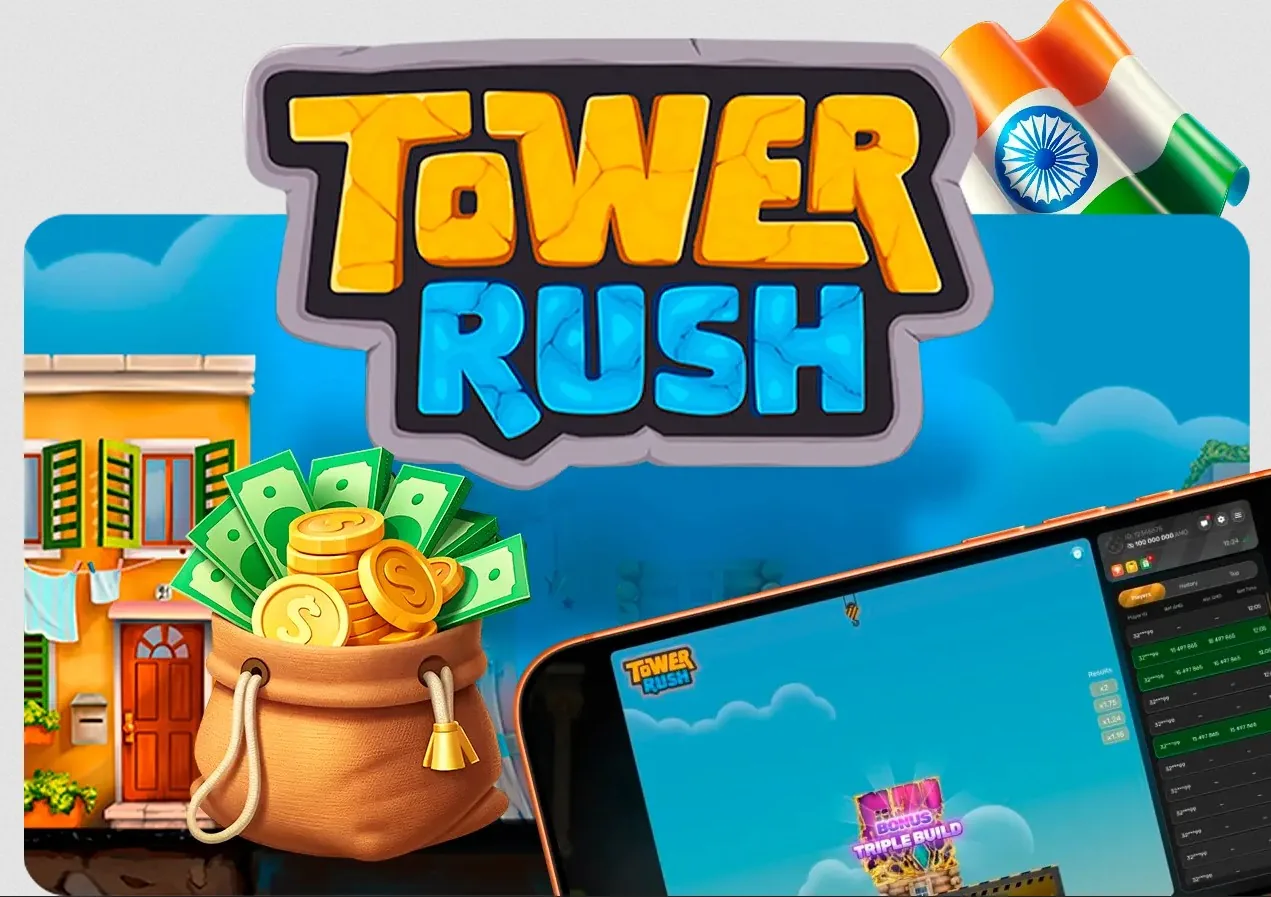
Tower Rush is a crash-style instant game from Galaxsys, released in 2024. You place a bet, a crane drops floors onto a tower, and every floor that lands multiplies your accumulated odds. You may cash out after any floor; if a floor fails, the tower collapses and the stake is gone. The published RTP is operator-configurable between 96.12% and 97%, most operators cap the win at 100x, and three random bonus floors — Frozen Floor, Temple Floor and Triple Build — change what a round can do without changing the long-run maths.
No registration, no deposit, no download.
Demo mode runs on virtual credits with the same rules and bonus floors as real play. No registration, no deposit, no download — and no real-money winnings.
The demo below is the full Galaxsys build running on virtual credits. Same rules, same three bonus floors, same RTP configuration — the only difference is that nothing you win or lose is real. It is the cheapest way to find out whether the rhythm of the game suits you, and it costs nothing but a tap. Full demo page and practice notes.
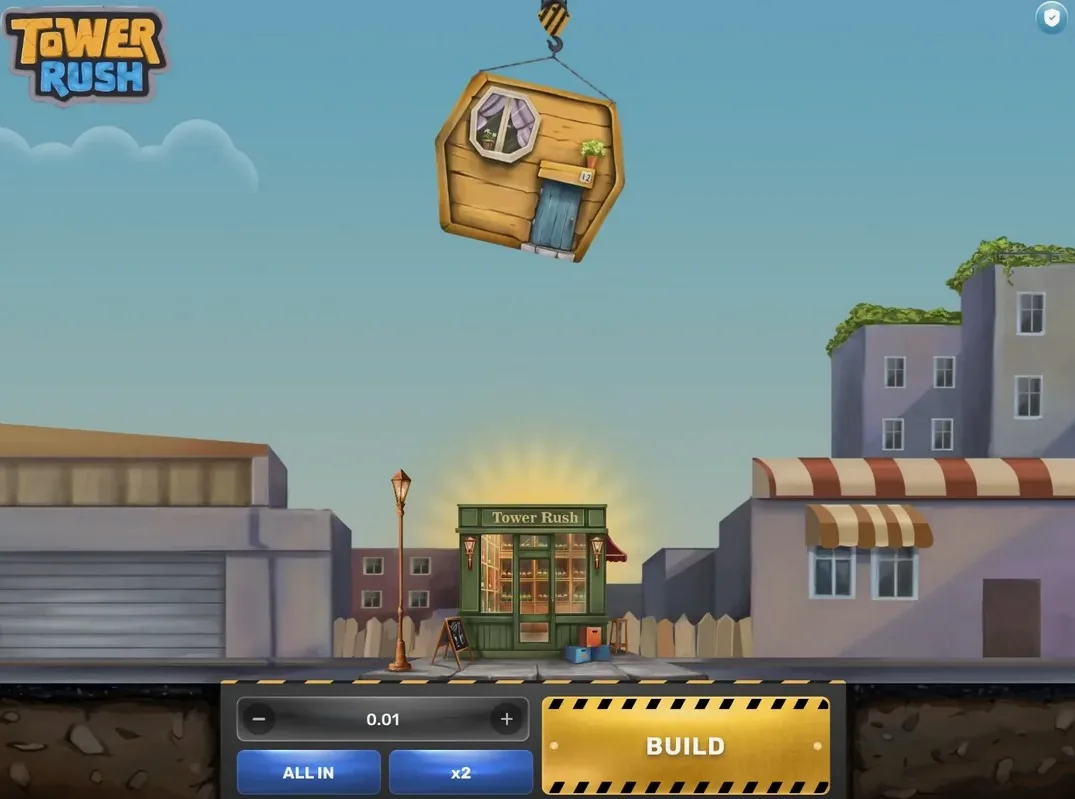
Tower Rush is a crash game, not a slot. There are no reels, no paylines and no symbol combinations. A crane hangs above an empty plot, you set your stake, and every time you press Build a floor drops onto the tower. Each floor that lands carries its own odds value, and those values compound: after six or seven successful floors a bet can already be worth several times what you put in.
The catch is the one every crash game shares. The tower can fail on any floor, and when it does the round ends immediately with nothing to collect. There is no partial payout, no consolation, no second chance — unless a Frozen Floor happens to have locked something in first. That single tension, one more floor or take the money, is the whole game, and it is why rounds that last thirty seconds can feel considerably longer.
Galaxsys built the game for the same audience that plays Aviator and Mines: players who want a fast, legible round with a decision in the middle of it, rather than a five-minute bonus feature they can only watch. Tower Rush landed well enough to take New Casino Game of 2024 at SiGMA Europe and Best Crash Game 2025 at SiGMA Africa, and Galaxsys itself was recognised at the Sigma Eurasia Awards in 2025.
| Specification | Detail |
|---|---|
| Provider | Galaxsys |
| Game type | Crash / instant (Fast Games category) |
| Released | 2024 |
| RTP | 96.12% – 97% (operator-configurable) |
| Volatility | High — you set the risk with your cash-out point |
| Maximum win | Commonly capped at 100x the stake |
| Bet range (India) | About ₹10 to ₹10,000 per round, set by the casino |
| Demo currency | 45 – 45,000 Fun credits |
| Bonus features | Frozen Floor, Temple Floor, Triple Build |
| Bonus buy | Not available |
| Auto cash-out | Not available |
| Fairness | Provably fair, certified RNG |
| Platform | HTML5 — browser, Android and iOS |
| Round length | Roughly 10 to 40 seconds |
Two of those rows deserve a second look before you play. There is no bonus buy, so the three bonus floors cannot be purchased at any price — they arrive when the RNG says so. And there is no auto cash-out, which is the feature Aviator players most often miss here: every exit is a manual decision, taken in the moment, which is exactly when discipline is hardest.
A round has five beats. None of them is complicated, which is the point — you can learn the whole loop in about ninety seconds and then spend a long time getting the last beat wrong.
Choose the amount for this round. Indian casinos usually run Tower Rush from about ₹10 up to ₹10,000; the demo uses 45 to 45,000 Fun credits. The stake is locked once the round starts.
Press Build. The crane releases a floor onto the plot. If it lands, your running odds value appears on screen and your potential payout is stake multiplied by that value.
After every successful floor you get the same two buttons: Cash Out to bank what you have, or Build to add another floor at higher odds. This is the only real choice the game gives you.
A landed floor sometimes turns out to be a Frozen Floor, a Temple Floor or a Triple Build. You find out only after it lands — the bonus type is hidden until then.
Press Cash Out and the win is credited instantly at the current odds. Miss a floor and the tower falls, the round ends and the stake is lost — unless a Frozen Floor already locked part of it.
One rule surprises people who arrive from other crash titles: if you lose your connection mid-round, Galaxsys gives you one hour to reconnect, and any wins already registered are preserved. Operators are also required to refund every bet placed during a genuine game malfunction. Neither rule helps you win, but both are worth knowing before you assume a dropped signal cost you a round.
Step-by-step screens, interface labels and beginner mistakes are covered on the how to play Tower Rush page.
Here is the shape of the game in one picture. Your potential payout compounds floor by floor, which feels like steady progress. The probability that the tower is still standing decays at the same time, and it decays faster than the payout grows. The two lines cross the interesting part of the chart somewhere between the fourth and the eighth floor — which is, not coincidentally, where most experienced players take the money.
Illustrative only — the real sequence is fixed by the provably fair seed before the round starts. The shape is what matters: the payout climbs steadily, the odds of getting there fall away faster.
Read it this way: reaching x2 is routine, reaching x5 is a good round, and reaching x25 is a story you tell people. The reason a 96–97% RTP can coexist with a game where most rounds end in a collapse is that the rare tall towers pay for all the short ones. Nothing about that changes based on how long you play, how you tap, or what the previous ten rounds did.
Illustrative modelling, not a promise. Note the trade-off: a higher target pays more when it lands but lands far less often, and every plan sits under the same 96–97% RTP.
The second chart is the same idea from the player's side. A plan to cash out at x2 lands most of the time and pays little. A plan to chase x25 almost never lands and pays a lot when it does. Both plans return roughly the same amount over thousands of rounds, because both sit under the same RTP — what changes is how bumpy the ride is and how quickly a bad run empties a small balance.
Plenty of casinos file Tower Rush under slots, and plenty of players arrive expecting one. It behaves very differently, and the differences matter for how you budget a session.
| Tower Rush | Typical online slot | |
|---|---|---|
| Core action | Stack floors, then choose to stop | Spin and watch the result |
| Player decisions per round | One after every floor | None after the spin |
| Round length | 10 – 40 seconds, player-controlled | 3 – 6 seconds, fixed |
| Paylines | None | 10 – 243 or cluster pays |
| Bonus trigger | Random bonus floors mid-round | Scatter symbols |
| Bonus buy | Not available | Often available |
| Typical RTP | 96.12 – 97% | 95 – 96.5% |
| Who sets the risk | The player, via cash-out point | The game's volatility rating |
| Result decided | Before the round, by the seed | At the moment of the spin |
A slot decides everything the moment you press spin. Tower Rush hands the decision back to you after every single floor, which is more engaging and, for some players, considerably more dangerous.
A cautious round is over in ten seconds; a greedy one runs past forty. You are not locked into a fixed pace, so sessions stretch without feeling like they have.
Slots publish an RTP and ask you to trust the certification. Tower Rush lets you check the hash of an individual round after it has finished.
There is no single volatility rating that fits the game, because a player who always leaves at x2 and one who always chases x20 are effectively playing two different games.
Bonus floors look exactly like ordinary floors while they are falling. You learn what you got only after the floor lands successfully — which means a bonus never rescues a failed build, it only improves a round that was already going well.
Locks your current win. From that moment a collapse cannot take the frozen amount away, and only a larger win later in the round replaces it. Once it triggers, no further bonus floors can appear in the same round, and only one Frozen Floor can occur per round.
Spins a ten-segment wheel: x1.5, x2, x3, x5 and x7 multipliers plus one Freeze segment. The multiplier applies to your accumulated total, not to your original stake — so the later it lands, the more it is worth. Unlike the Frozen Floor, it can trigger more than once per round.
Instantly stacks three floors, each with odds of x1 or better. It is the most common of the three and it cuts both ways: early in a round it is a fast lift, but on a tall tower it takes three collapse chances in a single click.
The wheel multiplies your accumulated total, not your original stake — so the later a Temple Floor lands in a round, the more it is worth.
Bonus floors are triggered by the RNG, not by how you play. They redistribute variance inside a round — they do not change the long-run RTP.
A note that saves a lot of confusion: some floors carry odds below x1. A successful build can therefore leave your total slightly lower than it was. That is not a bug and it is not the casino cheating — it is how the odds distribution is built, and Triple Build guarantees a minimum of x1 per floor precisely because ordinary floors do not.
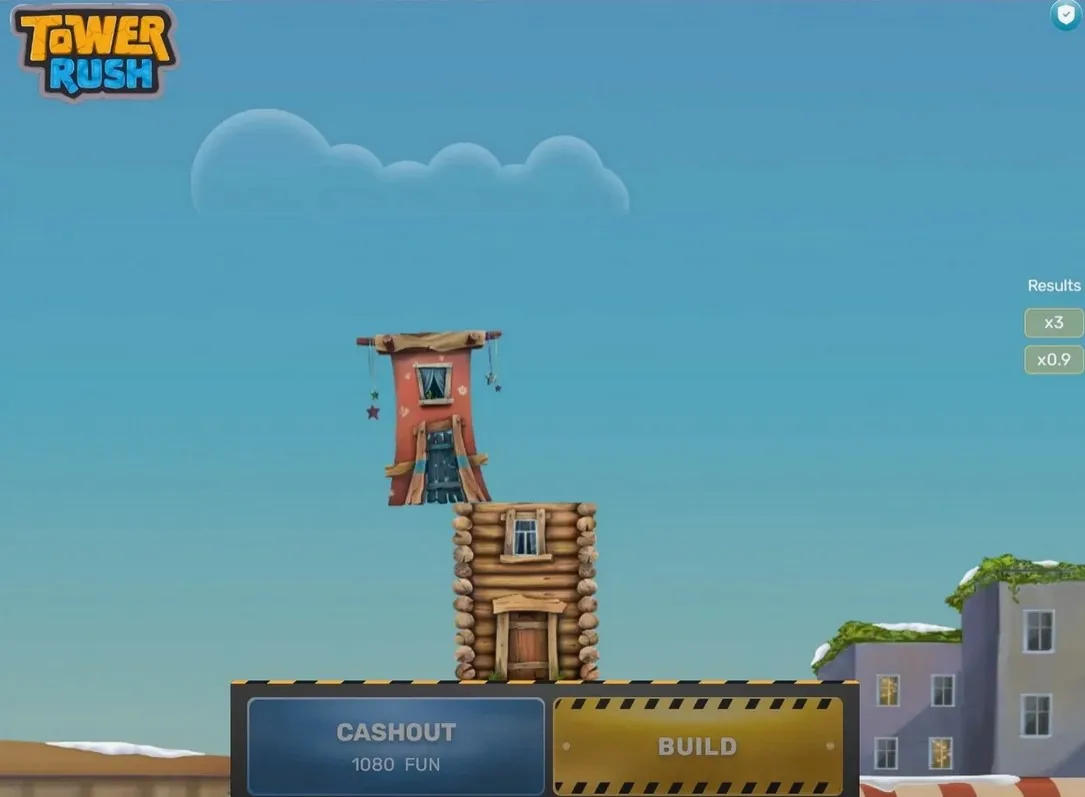
Full mechanics, trigger conditions and how to play each one: the Tower Rush bonus floors guide.
Tower Rush runs on a certified RNG with provably fair verification. Before your round begins, the server generates the entire sequence of results — every floor's odds, every bonus trigger and the exact floor on which the tower falls — hashes it, and shows you the hash before you place the bet. After the round the seed is revealed, and you can confirm that the result you saw matches the result that was committed to in advance.
That last point is where a lot of marketing gets it wrong. Provably fair means verifiable, not beatable. Because the sequence is fixed before the first floor drops, no amount of timing, tapping rhythm or "reading the crane" affects anything. Every video promising a tapping trick, a pencil trick or a rubber-band hack is selling you a story about a result that was already written.
What you actually control is the cash-out point, the stake size and how long the session runs. That is a short list, but it is the entire list, and treating it as such is the difference between playing this game well and playing it expensively.
Tower Rush ships with a configurable RTP. Operators choose a profile, most commonly somewhere between 96.12% and 97%, and the active figure is shown inside the game's own info screen. Those numbers are not decoration: on ₹10,000 of turnover the difference between the two ends of the range is roughly ₹88 in expected return. Small per round, meaningful across a month.
Tower Rush is operator-configurable between roughly 96.12% and 97%. The figure above is the best case — always check the RTP shown in the game's own info screen at the casino you use.
At the top of its range Tower Rush sits level with the best-known crash titles and comfortably above the average online slot. That is a genuine advantage, and it is also the single easiest thing for a casino to quietly downgrade — which is why checking the info screen at your specific operator is worth the ten seconds it takes.
| Metric | Figure | What it means for a session |
|---|---|---|
| RTP | 96.12 – 97% | Expect to lose roughly ₹3–₹4 of every ₹100 wagered over a long run |
| House edge | 3 – 3.88% | The margin the operator keeps; it never switches off |
| Volatility | High, player-controlled | Leaving early smooths the curve, chasing multiplies the swings |
| Max win | Commonly 100x | Once reached, extra floors add nothing to the round |
| Hit pattern | Frequent small, rare large | Most rounds end at low multipliers even when played well |
| Bonus frequency | Several per session | Bonus floors change variance, not RTP |
On the max win: 100x is the figure most operators publish, but the cap is configurable and some builds run lower. Treat any site advertising four-figure or five-figure multipliers on Tower Rush with suspicion, and check the paytable rather than the affiliate copy.
Same game, same RTP, very different ride. The cautious line drifts; the aggressive line whipsaws. Neither escapes the house edge over a long enough session.
If you already play crash games, the useful question is not whether Tower Rush is good but what it does that Aviator, Mines and JetX do not.
| Feature | Tower Rush | Aviator | Mines | JetX |
|---|---|---|---|---|
| Provider | Galaxsys | Spribe | BGaming | SmartSoft |
| Core mechanic | Stack floors | Rising curve | Reveal safe tiles | Rising curve |
| Top published RTP | 97% | 97% | 97% | 97% |
| Bonus features | 3 bonus floors | None | None | None |
| Auto cash-out | No | Yes | N/A | Yes |
| Two simultaneous bets | No | Yes | No | Yes |
| Provably fair | Yes | Yes | Yes | Yes |
| Round pace | Player-paced | Fixed, ~5–30s | Player-paced | Fixed, ~5–30s |
| Loss protection | Frozen Floor | None | None | None |
| Learning curve | Very low | Very low | Low | Very low |
Two honest conclusions come out of that table. Where Tower Rush wins: it is the only one of the four with an in-round loss protection mechanic, and the bonus floors give a round texture that a plain rising curve does not have. Where it loses: no auto cash-out and no dual bet. If your Aviator routine is built on setting a target and letting the software execute it, Tower Rush will feel like it removed your safety net — because it did.
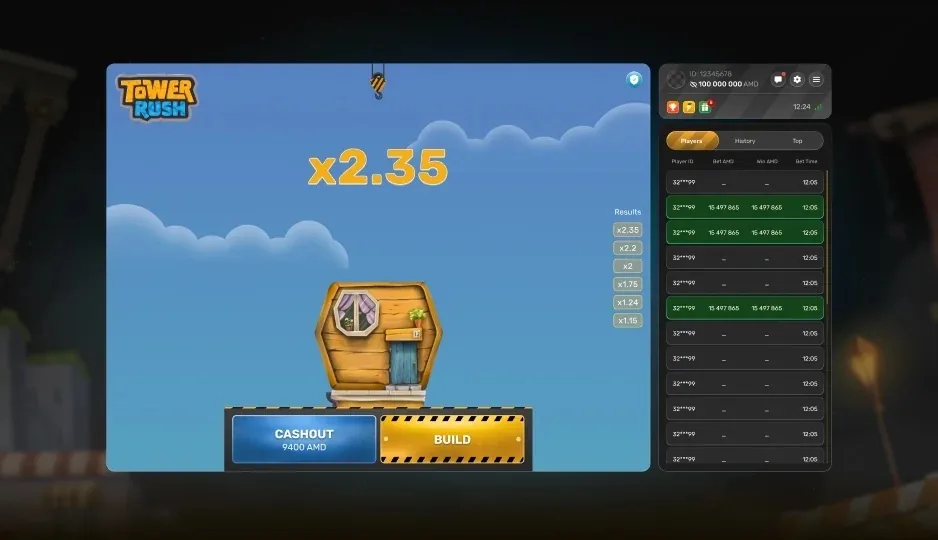
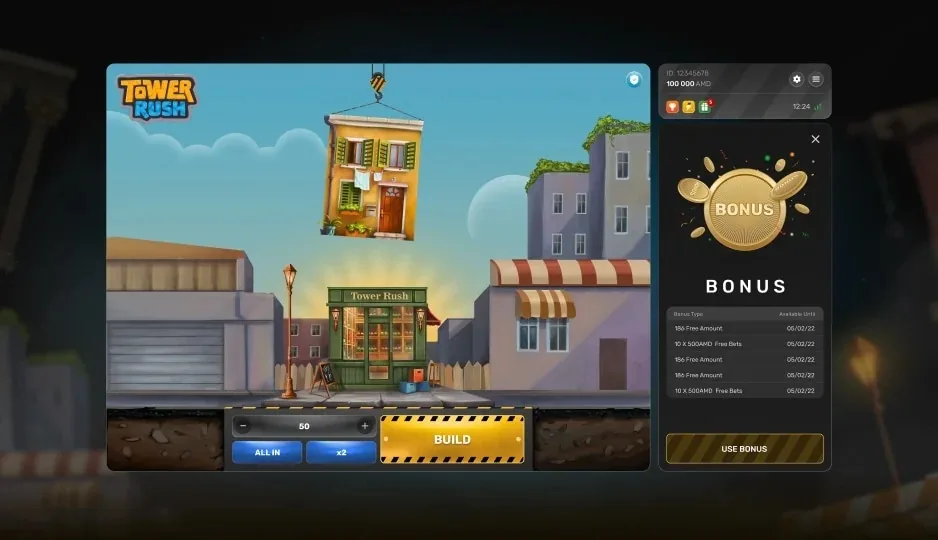
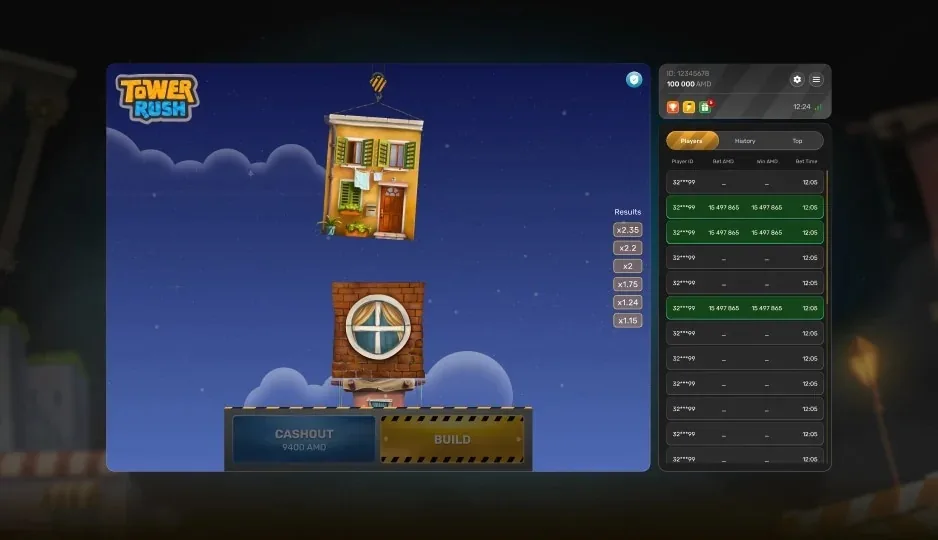
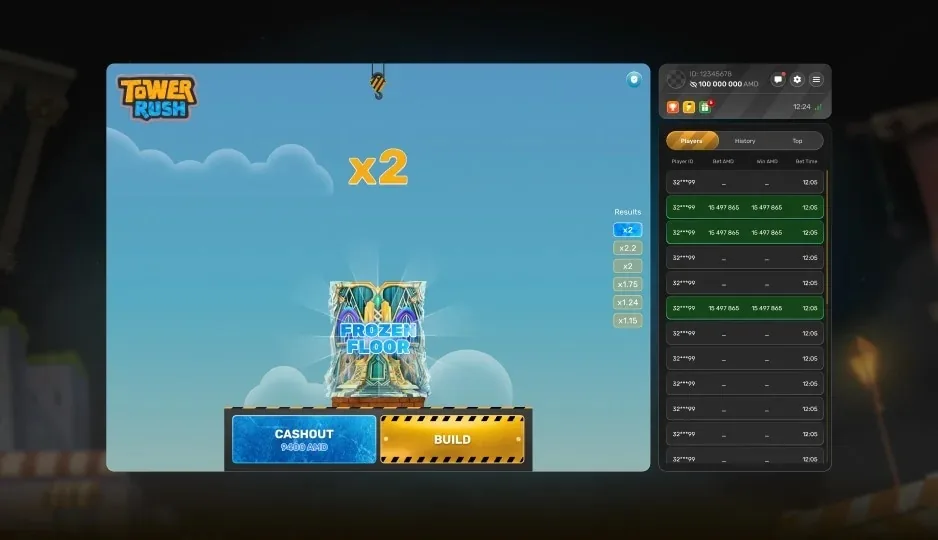
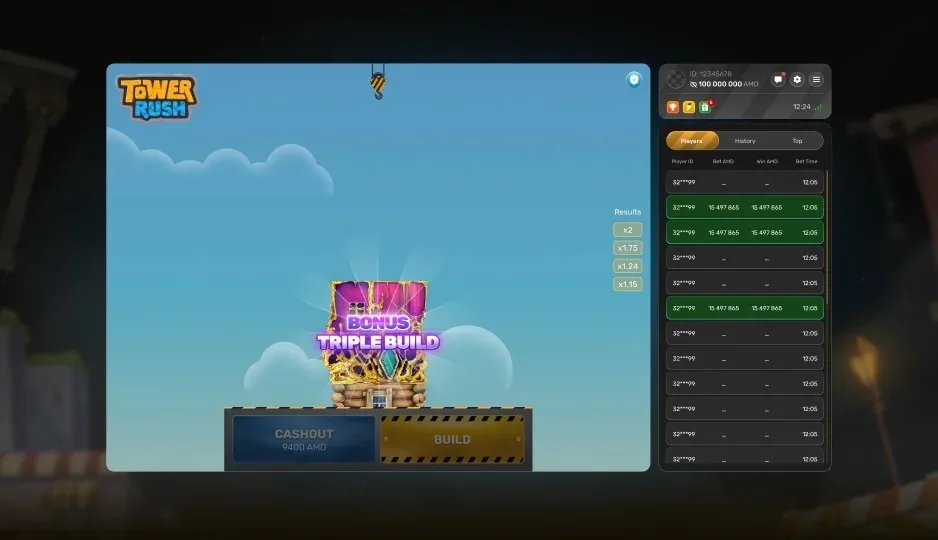
The interface is deliberately sparse: stake, Build, Cash Out, the running odds and a short history strip. There is no clutter to learn and nothing hidden in a sub-menu — which is part of why the game reads well on a phone screen held one-handed on a commute.
Watching someone else play is the fastest way to calibrate expectations. Note how often the round ends in the first handful of floors, and how quickly the on-screen decision has to be made once the odds start looking interesting. That gap between "I know I should cash out" and actually pressing the button is the part no guide can teach you.
Recurring themes from player discussions across crash-game forums and review threads, including the criticism. Paraphrased in our own words — not direct quotes.
The Frozen Floor changes how I play the whole round. Before it triggers I'm cautious; after it triggers I push, because the worst case is that I still walk away with the frozen amount.
Nobody warns you that some floors carry odds under x1, so your total can dip after a successful build. I thought the game had glitched the first time it happened. It hasn't — that's just the maths.
The missing auto cash-out is the real complaint. On Aviator I set 2.0x and forget about it. Here every exit is manual, and manual means emotional. That's a design choice, and I don't think it's in the player's favour.
People keep sharing tapping patterns and 'crane timing' tricks. The result is decided by the seed before the first floor drops. If a timing trick worked, the hash wouldn't verify — and it always does.
Triple Build early in a round is the best thing in the game. Triple Build when you're already at x12 is three collapse rolls at once and I've lost more to that than to anything else.
Rounds are short enough that 'one more' is very easy to say. I set a round count now instead of a time limit, because twenty minutes here is a lot more rounds than twenty minutes on a slot.
Learned it in a single demo session. The bonus floors keep it from getting repetitive and the phone build never stutters, even on mobile data.
Great pacing and a genuinely fair-feeling system. Marked down one star because there is no auto cash-out, which I miss badly on longer sessions.
The 100x ceiling is modest next to a big slot, but you actually get near it more often than you get near a slot's headline number. Fair trade.
That last line is not filler. A game with a manual exit, a ten-second round and a visible near-miss on every collapse is close to the worst possible format for anyone who finds it hard to walk away. If that describes you even occasionally, the demo is the version to play, and our responsible play guide has the practical limits worth setting first.
Tower Rush is a Galaxsys title, so you play it at a licensed casino that carries the Galaxsys catalogue rather than on a standalone site. For Indian players the practical filters are the same three every time: does it accept INR, does it support UPI, and how fast does it actually pay out.
Full selection criteria, deposit and withdrawal notes, and the warning signs of a fake Tower Rush site are on the where to play Tower Rush page. Whatever you pick, check the game's own info screen for the active RTP before your first real-money round — it is the one number an operator can change and nobody advertises.
There is no official Tower Rush app and no official APK. The game is HTML5 and runs in any modern mobile browser, which is why the portrait layout, the oversized Build button and the single-thumb cash-out all work as well as they do. Anything advertising itself as a downloadable Tower Rush APK is not from Galaxsys.
Device notes, data usage and how to add the game to your home screen safely: Tower Rush on mobile.
Galaxsys is an Armenian studio specialising in fast games — the instant, crash and skill-adjacent category that sits between slots and live casino. Its catalogue includes Crash X, Rocketon, Dice and Tower Rush, and it distributes through the major aggregators, which is why the same game turns up at operators that otherwise share very little.
The house style is consistent: short rounds, a legible interface, provably fair verification on every game, and a mechanic that gives the player one meaningful decision. Tower Rush is the clearest expression of that formula and the title that made the studio's name outside the trade press, taking New Casino Game of 2024 at SiGMA Europe and Best Crash Game 2025 at SiGMA Africa.
Tower Rush is a crash-style instant game by Galaxsys. Instead of spinning reels you stack floors on a tower. Every floor that lands successfully multiplies your accumulated odds, and you can cash out at any point. If a floor fails, the tower collapses and the stake is lost.
The RTP is operator-configurable between roughly 96.12% and 97%. The exact figure is shown inside the game's own information screen at the casino you are using, and it is worth checking — the difference across that range is about ₹88 per ₹10,000 wagered.
No. The stacking animation is cosmetic. Every result in the round — the odds on each floor, which bonus floors appear and the floor on which the tower collapses — is fixed by the provably fair seed before you place the bet. The only thing you control is when to cash out.
Yes. The demo on this page and on the demo page runs the complete game on virtual credits with the same rules and bonus floors. No registration, deposit or download is needed, and no real money can be won.
Frozen Floor locks your current win so a later collapse cannot take it. Temple Floor spins a ten-segment wheel with x1.5, x2, x3, x5 and x7 multipliers plus one free freeze. Triple Build instantly stacks three floors, each at odds of x1 or better. Full detail is on the bonus floors page.
Most operators publish a cap of 100x the stake, though the ceiling is configurable and some builds run lower. Once the cap is reached, additional floors stop adding value to the round.
No. There is no bonus-buy and no ante-bet. All three bonus floors are triggered by the RNG only, which is why no site can sell you a shortcut to them.
No. Unlike Aviator and JetX, Tower Rush has no automatic cash-out and no dual-bet option. Every exit is a manual press, which is the most common criticism experienced crash players make of the game.
Galaxsys allows one hour to reconnect, and any wins already registered in the round are preserved. Operators also refund bets placed during a genuine game malfunction.
Yes, and it is not a fault. Some floors carry odds below x1, so a successful build can slightly reduce your accumulated total. Triple Build guarantees a minimum of x1 per floor precisely because ordinary floors do not.
Yes. It is built in HTML5 and runs in any modern browser on Android and iOS. There is no official app or APK — avoid any download that claims otherwise. See the mobile page.
At licensed casinos that carry the Galaxsys catalogue and accept INR with UPI. Our shortlist and the criteria behind it are on the where to play page. Always confirm the active RTP in the game's info screen before your first real round.
crash & instant-games editor
Rahul has covered instant and crash games since the category arrived in the Indian market, and has logged several hundred rounds of Tower Rush across demo and real-money builds at three different operators. He writes the RTP, bonus and fairness sections on this site and re-checks the published figures against the in-game info screen each quarter.