The complete rules of the Galaxsys crash game: the build-or-cash-out loop, what every button does,
how the three bonus floors change a round, and which cash-out plans survive contact with reality.
Learn time~2 minutes
Round length10 – 40 sec
DecisionsOne per floor
RMWritten and fact-checked by Rahul Menon, crash & instant-games editor · Updated July 2026 · Rules verified against the in-game help screen
Quick answer
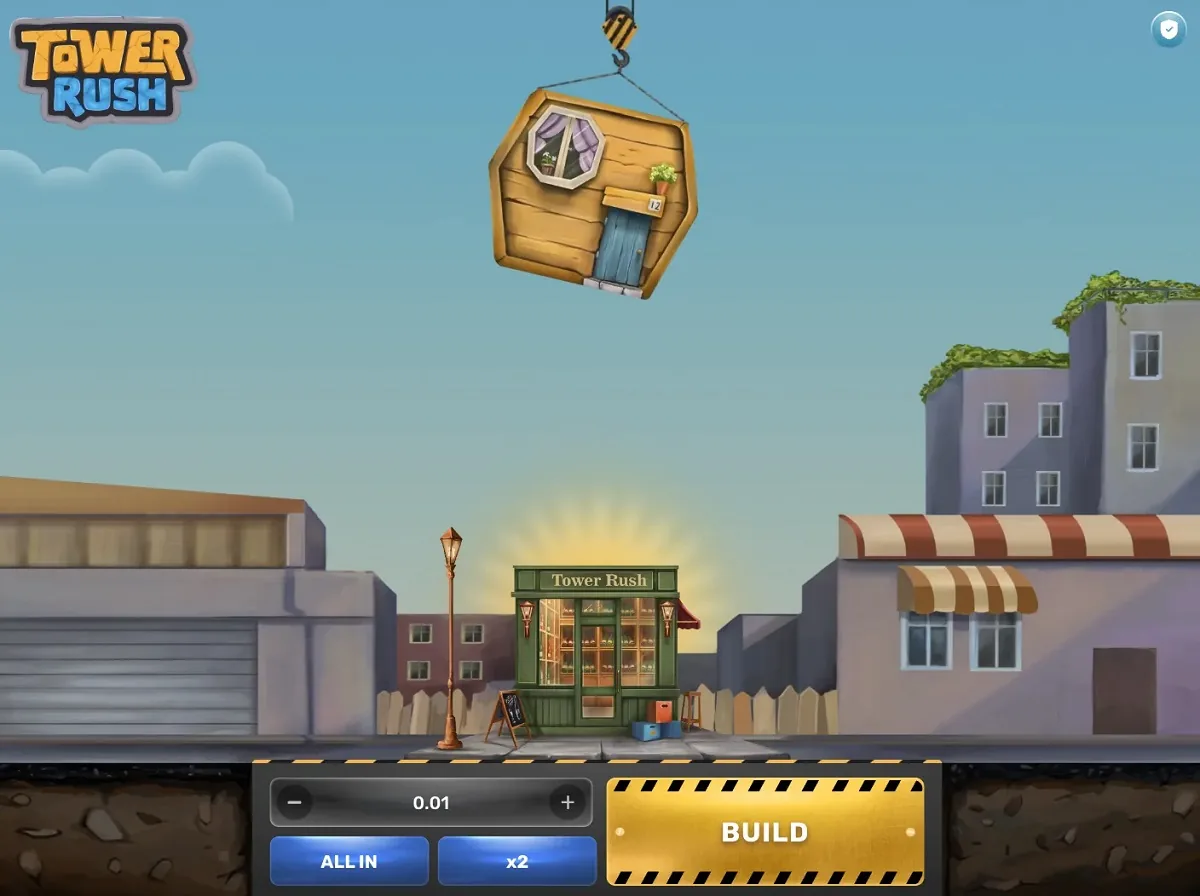
To play Tower Rush: set your stake, press Build to drop a floor onto the tower, and repeat. Every floor that lands multiplies your accumulated odds. Press Cash Out after any floor to bank the win at the current value. If a floor fails, the tower collapses and the stake is lost. Bonus floors — Frozen, Temple and Triple Build — appear at random and are revealed only after a floor has landed. There is no auto cash-out, so every exit is a manual decision.
Gambling should be entertainment, never a way to earn money. Tower Rush has a house edge on every
round — set a budget, set a stop-loss and never chase losses. 18+ only.
Start here
Before your first round
Tower Rush has one of the shortest rule sets in the casino. You are not learning paylines, scatter combinations
or a bonus ladder — you are learning one loop and one decision. The whole game is: a floor lands, your odds go
up, and you choose whether to stop. Everything below is detail hanging off that sentence.
What makes the game harder than it looks is not the rules but the pace. A round can be over in ten seconds, and
the decision that matters most sits in the middle of it, when the number on screen has just become interesting.
Learning the rules takes two minutes. Learning to press Cash Out when you said you would takes considerably
longer, which is why the free demo exists.
The result of the round is decided before your first floor drops — see why that matters.
There is no auto cash-out and no autoplay. Every action is a manual press.
A successful floor can occasionally lower your total, because some floors carry odds below x1.
Bonus floors never rescue a failed build — they only improve a round that was already going well.
The demo uses the same rules, the same bonus floors and the same RTP configuration as real play.
The loop
The five steps of a round
1
Set your stake
Use the plus and minus controls, or a preset chip, to pick the amount for this round. Most Indian operators run from about ₹10 to ₹10,000; the demo uses 45 to 45,000 Fun credits. The stake cannot be changed once the round has started.
2
Press Build
The crane above the plot releases the first floor. If it lands, the running odds value appears on screen and your potential payout becomes stake × odds. The first floor almost always lands — it is the fourth and fifth that start biting.
3
Cash Out or Build again
Two buttons, one decision, repeated. Cash Out credits the win instantly at the current odds. Build adds another floor at higher odds and a higher chance of ending the round with nothing.
4
Read the bonus floor
If a landed floor is a bonus, it reveals itself now: Frozen locks your win, Temple opens the wheel, Triple Build stacks three floors at once. You cannot see it coming and you cannot buy it.
5
Bank it or lose it
Cash out and the amount goes straight to your balance. Miss a floor and the tower collapses — the round ends, the stake is gone, and only a previously triggered Frozen Floor pays anything.
The loop repeats until one of two things happens: you press Cash Out, or a floor fails. There is no third
outcome and no partial payout in between. That is the entire game, and the reason it is worth writing five
thousand words about is that the third step is where all of the money is made and lost.
Interface
Reading the game screen
The layout is deliberately spare. Nothing is buried in a sub-menu and nothing needs configuring before you
start — which is good, because at this pace you will not have time to look for it.
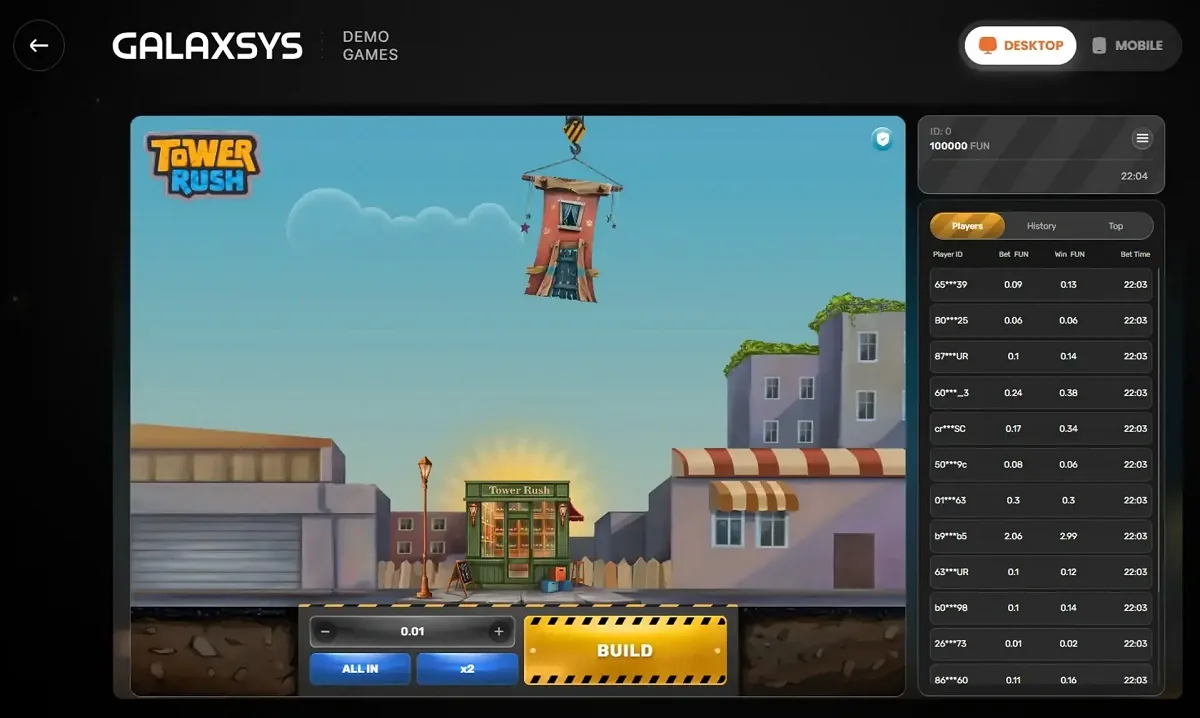
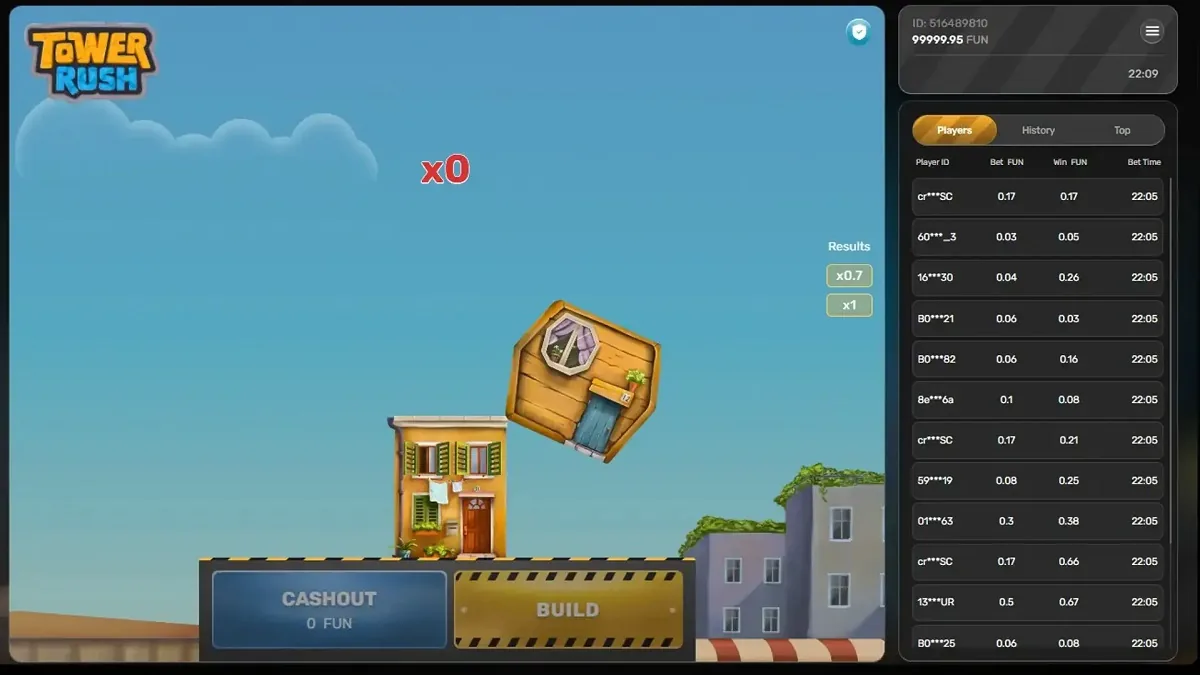
What each element of the Tower Rush interface does
Element
Where it is
What it tells you
Stake control
Bottom of the screen
The amount committed to this round; locked once the round starts
Build button
Primary control, centre-bottom
Drops the next floor from the crane
Cash Out button
Replaces Build after a landing
Banks the win at the odds currently shown
Running odds
Above the tower
Your cumulative multiplier so far this round
Potential payout
Beside the odds
Stake × running odds — what Cash Out would pay right now
Round history
Strip along the top or side
Previous results; useful context, zero predictive value
Hash / fairness icon
Info or settings menu
The committed seed hash for verification
Balance
Top of the screen
Real balance, bonus balance or Fun credits depending on mode
Info screen
Menu button
Where the active RTP for your casino is published
Two of those rows are worth acting on. The info screen carries the RTP your specific operator
has configured — the only number on this page a casino can quietly change. And the round history
is the single most misread element in every crash game: a run of short towers tells you precisely nothing about
the next round, because each round is generated independently.
Limits
Bets, limits and the win cap
Bet limits are set by the operator, not by Galaxsys, so the exact numbers move between casinos. These are the
ranges you will typically meet.
Tower Rush bet limits and caps as commonly configured
Setting
Typical range
Notes
Minimum bet (INR)
₹10 – ₹20
Low enough to learn on without burning a balance
Maximum bet (INR)
₹10,000
Some operators cap lower for new accounts
Minimum bet (EUR builds)
€0.05
The common European configuration
Maximum bet (EUR builds)
€1,000
Per round, not per session
Demo credits
45 – 45,000 Fun
Virtual only; cannot be withdrawn
Maximum win
Commonly 100x the stake
Configurable; further floors add nothing once reached
Disconnect grace
1 hour to reconnect
Registered wins in the round are preserved
Malfunction policy
All bets refunded
Standard across licensed operators
If you are playing with a bonus balance rather than cash, one rule catches people out: the bonus must be
activated before the round, and if the bonus balance sits below the minimum bet the game refuses the wager with
an insufficient-balance message. To bet real money instead, deactivate the bonus first.
The maths
How the odds actually compound
Every floor carries its own odds value, and the values multiply together rather than adding. That is why the
curve looks gentle for three floors and then steepens: x1.3 four times over is x2.9, but eight times over is
x8.2. The collapse probability compounds in the same direction, only faster.
Multiplier growth vs collapse riskIllustrative model of a Tower Rush round, floor by floor
Illustrative only — the real sequence is fixed by the provably fair seed before the round starts. The shape is what matters: the payout climbs steadily, the odds of getting there fall away faster.
The formula on the payout side is as simple as it looks:
Payout formula
Win = stake × accumulated odds at the moment you press Cash Out. Nothing else enters the
calculation. A Temple Floor multiplier applies to the accumulated total, so it also flows through this formula
rather than sitting beside it.
One consequence deserves stating plainly, because it is the most common misunderstanding about the game: a
successful floor can carry odds below x1, which reduces your accumulated total slightly. The tower did
not fail, the game did not glitch — the floor simply carried a value under one. Triple Build guarantees a
minimum of x1 on each of its three floors, and it is worth asking why that guarantee needs to exist at all.
Bonus floors
Playing the three bonus floors
You cannot influence when a bonus floor appears, but you can play the round differently once one has. Each of
the three changes the correct decision in a different direction.
Frozen Floor — push, do not stop
Your current win is locked and a collapse can no longer take it. Only a larger win replaces the frozen amount, so cashing out immediately after a freeze wastes the protection you were just handed. Keep building — the downside is already capped. Note that no further bonus floors can appear afterwards, and only one freeze is possible per round.
Temple Floor — value grows with height
The wheel multiplies your accumulated total, not your stake, so a Temple Floor at x8 is worth roughly four times one at x2. It can trigger more than once in a round, which is a genuine argument against cashing out the moment the first one pays.
Triple Build — great early, dangerous late
Three floors in one click, each at x1 or better. Early in a round, when collapse odds are low, it is the fastest lift in the game. On a tall tower it is three collapse chances taken simultaneously — many players treat a late Triple Build as their cue to cash out immediately after it lands.
How often each bonus floor shows upRelative frequency of Triple Build, Temple Floor and Frozen Floor
Bonus floors are triggered by the RNG, not by how you play. They redistribute variance inside a round — they do not change the long-run RTP.
None of this changes the RTP. Bonus floors redistribute variance inside a round: they make good rounds better
and leave bad rounds exactly as bad. A full breakdown of trigger conditions, the wheel's segment weighting and
the interaction rules is on the bonus floors page.
On video
Watch the loop before you play it
A complete round from stake to cash-out, including what a bonus floor looks like when it lands. Video is hosted on YouTube and only loads after you tap it, so the page stays fast.
Two things to watch for. First, how many rounds end inside the first five floors — far more than the highlight
clips suggest. Second, the length of the pause before each Cash Out press. That hesitation is the actual
difficulty of the game, and it is the reason a written plan beats an in-the-moment judgement almost every time.
Cash-out plans
Four approaches compared
Because the RTP is identical at every exit point, no cash-out target is mathematically superior. What differs is
the shape of the outcome: how often you win, how much you win, and how fast a bad run can empty a small
balance. Pick the shape you can live with.
Which cash-out plan actually pays outShare of rounds that reach the target before the tower falls
Illustrative modelling, not a promise. Note the trade-off: a higher target pays more when it lands but lands far less often, and every plan sits under the same 96–97% RTP.
Four Tower Rush cash-out plans and what each one feels like
Plan
Target
How often it lands
Best suited to
Grinder
x1.8 – x2.2
Most rounds
Small balances, learning the game, bonus wagering
Balanced
x3 – x5
Roughly two rounds in five
Regular sessions where variance is tolerable
Hunter
x8 – x12
Roughly one round in five
Larger balances and patient players
Ceiling chaser
x25 and above
Rarely
Entertainment only — expect long losing streaks
A
Fixed-target discipline
Decide the number before the round starts and take it every single time, with no exceptions for a round that 'feels hot'. This is the only plan that removes the in-the-moment decision, which is the part most players get wrong.
B
Frozen-Floor aggression
Play a conservative target normally, but push hard whenever a Frozen Floor triggers, since the downside is already locked. This is the closest thing in the game to a free roll.
C
Step-down after a win
Bank a big round, then drop back to the minimum stake for the next few. It does not improve your odds, but it protects the win you just took from being handed straight back.
D
Round-count sessions
Set a number of rounds — thirty, say — rather than a time limit. Tower Rush rounds are short, so twenty minutes is far more exposure here than twenty minutes on a slot.
Bankroll
Rules that hold up under pressure
None of these improve your odds. All of them change how long you last and how you feel afterwards, which for a
game with a house edge is the only lever available.
Two ways to spend the same balanceIllustrative session curves from a 100-unit starting balance
Same game, same RTP, very different ride. The cautious line drifts; the aggressive line whipsaws. Neither escapes the house edge over a long enough session.
Stake ≤ 2% of the session balance. On ₹2,000 that is ₹40 a round — enough for fifty rounds before variance decides anything.
Set the target before the round. Writing it down beats deciding at x4.7 with the button under your thumb.
Use a hard loss stop. A fixed rupee figure, decided in advance, that ends the session regardless of what happened last round.
Use a win stop too. Most players are far better at setting the first one than the second, which is how good sessions become bad ones.
Never increase the stake after a loss. Martingale on a game with no fixed win probability per round is a fast way to hit the table maximum with nothing to show.
Count rounds, not minutes. A short round length is exactly what makes session creep invisible here.
Play the first thirty rounds in demo. Free rounds cost nothing and teach the same rhythm.
If any of these feel unnecessary, that is worth noticing on its own. The
responsible play guide covers the warning signs, deposit and session limits, and
the support services available in India.
Avoid these
Nine mistakes beginners make
1
Reading the history strip
Six short towers in a row does not make a tall one due. Each round is generated independently from its own seed. The history strip is decoration.
2
Believing the animation
The crane, the swing and the landing are a visualisation of a result that was fixed before the round started. There is no timing skill in the click.
3
Cashing out immediately after a freeze
A Frozen Floor caps your downside. Taking the money right away throws away the one moment the game hands you protection for free.
4
Chasing the 100x cap
The maximum win exists, but reaching it requires a run so long that most balances are gone first. Treat it as a lottery outcome, not a plan.
5
Raising the stake after a loss
Loss-chasing on a high-variance game with no per-round win probability is how a manageable session becomes an expensive one in under ten minutes.
6
Skipping the RTP check
The active figure sits in the game's info screen and moves between 96.12% and 97% by operator. Ten seconds of checking is worth more than any strategy on this page.
7
Playing tired or annoyed
This game asks for a decision every eight seconds. Fatigue and irritation both push that decision in the same direction — later.
8
Trusting a downloadable APK
There is no official Tower Rush app. Every APK claiming to be one comes from somewhere other than Galaxsys.
9
Playing the bonus without reading the terms
Instant games often contribute less than slots towards wagering requirements, and sometimes nothing at all. Check before assuming a bonus can be cleared here.
Fairness
Why Tower Rush hacks do not exist
Search the game's name and you will find predictor apps, signal groups, tapping patterns, pencil tricks and
rubber-band methods. All of them share a single flaw: they claim to influence a result that has already been
generated.
Before the round begins, the server produces the complete sequence — the odds on every floor, which bonus floors
appear and the exact floor on which the tower falls — hashes it, and shows you that hash. Your clicks reveal
that sequence; they do not create it. After the round the seed is published and you can verify the two match.
If any input could change the outcome, the hash would not verify, and it always does.
Predictor apps — cannot see a server seed they have no access to.
Signal groups — sell subscriptions, then take credit for the rounds that happened to win.
Tapping rhythms — the animation is cosmetic; the timing of your press changes nothing.
Pattern reading — rounds are independent; there is no pattern to read.
Bonus-floor triggers — there is no bonus buy and no input that summons one.
What is real: the fairness verification itself. Open the info menu, note the hash before your round, and check
it against the revealed seed afterwards. That is the one genuine advantage provably fair gives a player, and it
costs nothing to use.
Practise
Try it free before you stake anything
Demo mode runs on virtual credits with the same rules and bonus floors as
real play. No registration, no deposit, no download — and no real-money winnings.
Thirty demo rounds will teach you more than the rest of this page. Play them with a written target — say, cash
out at x3 every time — and count how often you actually did it. That number, not the rules, is what determines
how the real-money version goes. More practice notes on the demo page.
Questions
Frequently Asked Questions
How do you play Tower Rush?
Set a stake, press Build to drop a floor onto the tower, and repeat. Every floor that lands multiplies your accumulated odds. Press Cash Out at any point to bank the win at the value shown. If a floor fails, the tower collapses and the round is lost.
When is the best time to cash out?
There is no mathematically best point — the RTP is identical at every exit. In practice, the plans that work are the ones decided before the round starts. Most experienced players use a fixed target between x2 and x5 and take it without exception.
Is there a trick or a pattern to win Tower Rush?
No. The whole sequence is generated and hashed before you place your bet, so tapping rhythm, crane timing and pattern-reading have no effect on anything. See why hacks do not exist.
What is the minimum bet?
The operator sets it. Indian casinos commonly run Tower Rush from about ₹10 up to ₹10,000 per round, and the free demo uses 45 to 45,000 Fun credits.
Can my total go down after a successful floor?
Yes. Some floors carry odds below x1, so a successful build can reduce your accumulated total slightly. It is part of the odds distribution rather than a fault — and it is why Triple Build guarantees a minimum of x1 on each of its three floors.
Does Tower Rush have autoplay or auto cash-out?
Neither, and no dual-bet option either. Every build and every exit is a manual press. This is the most common complaint from players arriving from Aviator or JetX.
What happens if my connection drops mid-round?
You have one hour to reconnect, and any wins already registered in the round are preserved. Licensed operators also refund every bet placed during a genuine game malfunction.
Should I keep building after a Frozen Floor?
Usually yes. Once the freeze has locked your current win, a collapse can no longer take that amount, so continuing costs you nothing beyond the stake you already committed. Only a larger win replaces the frozen value.
Can I play Tower Rush for free to practise?
Yes — the free demo runs the complete game on virtual credits with the same rules and bonus floors. No registration or deposit is required.