Predictor apps
Sold as software that reads the next result. They cannot: the server seed is not exposed to any client, and the outcome is already fixed before the round renders. What they actually do is take a payment.
Several hundred rounds across demo and real-money builds at three operators. What the game does genuinely well, what it gets wrong, and whether the "is it a scam" videos have a point.

Tower Rush scores 4.4 / 5. It is a genuinely well-built crash game with one real differentiator — the Frozen Floor, the only in-round loss protection in the category — and an RTP that reaches 97% at the better operators. The two real weaknesses are the missing auto cash-out and a modest 100x win cap. It is legitimate and provably fair; the scams attached to its name are third-party predictor apps and fake APKs, not the game.
Tower Rush is the crash game for players who want to make a decision rather than watch a curve. The build loop is legible in under two minutes, the round length is short enough to fit into any gap in the day, and the three bonus floors give a round texture that Aviator and JetX simply do not have. The Frozen Floor in particular is a real design achievement: an in-round protection mechanic in a genre built entirely on all-or-nothing.
The weaknesses are equally clear. There is no auto cash-out and no dual bet, which means the discipline the game demands is entirely manual — and manual discipline is precisely what a ten-second round is designed to erode. The 100x ceiling is honest but modest. And the absence of a bonus buy, while arguably fairer, removes any way to plan a session around the features.
A high-RTP, verifiable, well-paced crash game that is better designed than most of its competitors and worse equipped to protect a player from themselves. Recommended — with a cash-out rule written down before you start.
The presentation is cartoon-construction rather than neon-casino: a crane, a plot of land, a stack of mismatched floors, and a colour palette closer to a mobile puzzle game than to a slot lobby. That is a deliberate choice and it works — the tower reads instantly at a glance, which matters when the decision window is a few seconds long.
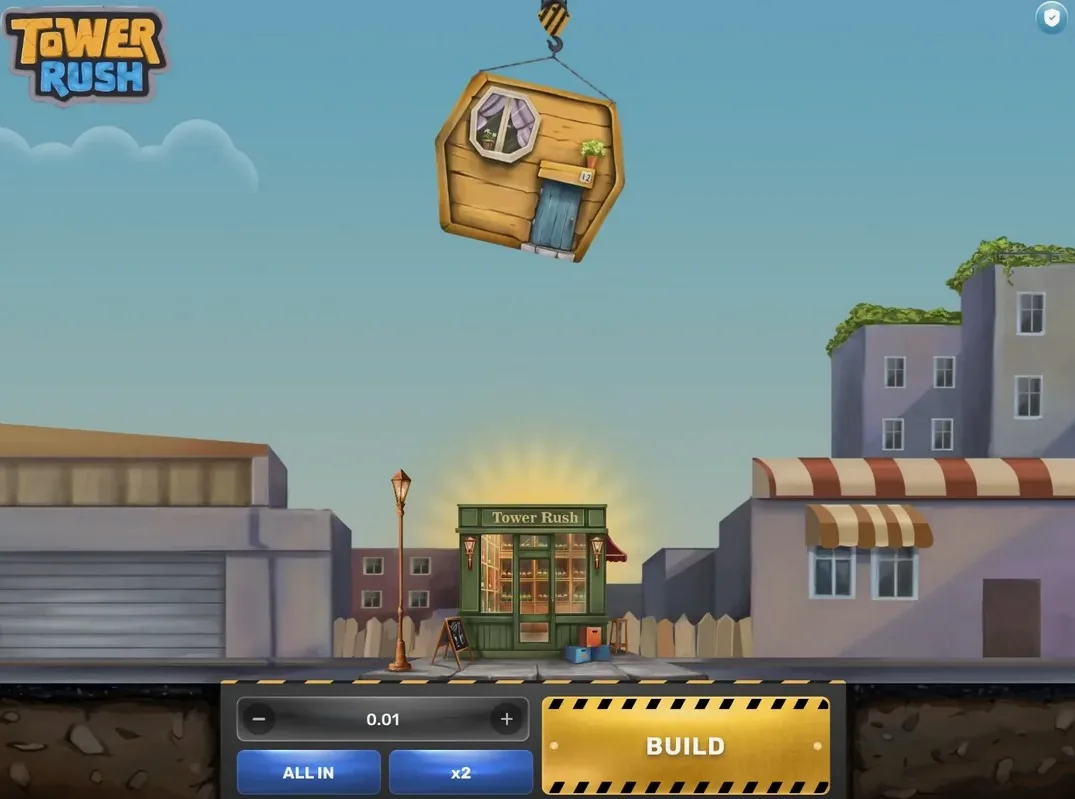
Sound design does real work here. The mechanical whine of the crane, the thud of a floor landing, the sharper chime when a bonus reveals itself, and the collapse — which is loud, sudden and unmistakably a loss. There is no background music track, only event cues, which keeps the pacing feeling player-driven rather than scored.
The interface is spare to the point of austerity: stake, one primary button, the running odds, a history strip. Nothing needs configuring and nothing is hidden. After twenty rounds you stop looking at the interface entirely, which is the highest compliment you can pay a design like this.
A round runs between ten and forty seconds depending entirely on how greedy you are, which is an unusual amount of control for a casino game. The first three floors land routinely; the fourth and fifth are where the game starts asking real questions; past the eighth you are in territory most sessions never see.
Illustrative only — the real sequence is fixed by the provably fair seed before the round starts. The shape is what matters: the payout climbs steadily, the odds of getting there fall away faster.
The pacing problem is subtle and worth naming. Because rounds are short and you control the exit, the game never imposes a natural break. A slot at least makes you press spin again. Here, the Cash Out press and the next Build press feel like part of the same motion, and twenty minutes disappears at a rate that surprises people. Counting rounds rather than minutes is the practical fix.
The single most common complaint from experienced crash players is structural: no auto cash-out. On Aviator you set 2.0x and let the software be disciplined for you. Here every exit is a manual press taken in the moment the number has just become interesting — which is the exact moment human judgement is worst. Whether that is engaging design or a dark pattern probably depends on how your last session went.
Three features, no bonus buy, all RNG-triggered. After a few hundred rounds, the ranking that emerged is not the one the marketing suggests.
| Bonus floor | Frequency | Impact | Our score |
|---|---|---|---|
| Frozen Floor | Rarest | Genuine loss protection — unique in the genre | 5 / 5 |
| Temple Floor | Moderate | Scales with tower height; can repeat | 4.5 / 5 |
| Triple Build | Most common | Excellent early, actively dangerous late | 3.5 / 5 |
Bonus floors are triggered by the RNG, not by how you play. They redistribute variance inside a round — they do not change the long-run RTP.
Frozen Floor is the reason to play this game over its competitors, and it is underused by most players, who instinctively cash out the moment it lands rather than exploiting the protection they were just given. Temple Floor is the biggest single source of large wins, because it multiplies the accumulated total rather than the stake. Triple Build is the most frequent and the most misunderstood — three floors in one click is three collapse chances taken simultaneously, and on a tall tower that is a liability dressed as a gift.
Full mechanics: the bonus floors guide.
Tower Rush publishes an operator-configurable RTP between 96.12% and 97%. At the top of that range it matches the best crash games on the market and comfortably beats the average slot.
Tower Rush is operator-configurable between roughly 96.12% and 97%. The figure above is the best case — always check the RTP shown in the game's own info screen at the casino you use.
The configurability is the catch, and it is the thing we would most like to see changed. Two players at two casinos can play what looks like the same game at meaningfully different returns, and the only way to know which you have is to open the info screen. Nobody advertises a downgrade.
| Metric | Figure | Assessment |
|---|---|---|
| RTP range | 96.12 – 97% | Strong at the top end |
| House edge | 3 – 3.88% | Standard for the category |
| Max win | Commonly 100x | Modest — the weakest number here |
| Volatility | High, player-set | A feature rather than a rating |
| Round length | 10 – 40 sec | Fast; watch session creep |
| Auto cash-out | None | The main structural gap |
| Bonus buy | None | Arguably fairer, less flexible |
| Provably fair | Yes | Verifiable per round |
On the 100x cap: it is low next to a modern slot's five-figure headline, but the honest comparison is how often you get near the ceiling, not how big the ceiling is. Tower Rush players reach a meaningful fraction of their maximum far more often than slot players reach theirs. That is a fair trade, and the game is upfront about it.
This is where Tower Rush is at its best. The portrait layout, the oversized Build button and the single-thumb cash-out are clearly designed phone-first rather than shrunk down from desktop, and the HTML5 client loads quickly enough on mobile data that a dropped round is rare.
There is no app, no APK and nothing to install, which is worth treating as a positive rather than an omission: every downloadable "Tower Rush app" you will find is unofficial. Add the browser page to your home screen if you play regularly and you have the same experience with none of the risk. Device notes: Tower Rush on mobile.
Short answer: yes, the game is legitimate. Galaxsys is a licensed B2B provider distributing through the major aggregators, and Tower Rush uses provably fair verification, which is a stronger guarantee than the certified-RNG claim most slots offer. You can check an individual round rather than trusting an annual audit.
"Legit" and "profitable" are different claims, and the confusion between them drives most of the accusations. Tower Rush is not rigged; it is a commercial product with a mathematical edge that is published on the info screen. Losing over a session is the expected outcome, not evidence of manipulation.
The one criticism with real substance is the configurable RTP. A player at a 96.12% operator is getting a measurably worse deal than one at 97%, and nothing in the interface flags the difference. That is not fraud, but it is not transparent either, and it is why we tell every reader to open the info screen first.
Videos like this one are worth watching for the questions they raise, and worth reading critically for how they answer them. The recurring confusion is the one above: a losing session is treated as proof of rigging, when it is the expected result of a 3% house edge over a short run.
The legitimate concerns that do surface in these discussions are real and worth repeating: unlicensed operators hosting cloned versions of the game, fake APK downloads, and the near-total absence of any warning that the RTP varies by casino. None of those are faults in the Galaxsys build; all of them can cost you money.
The game is fine. The ecosystem around it contains several things that are not. These are the ones that come up most often.
Sold as software that reads the next result. They cannot: the server seed is not exposed to any client, and the outcome is already fixed before the round renders. What they actually do is take a payment.
Paid channels posting 'safe rounds'. The business model is subscriptions plus survivorship bias — the winning calls get screenshotted and the losing ones quietly disappear.
There is no official Tower Rush app. Every downloadable APK using the name comes from somewhere other than Galaxsys, and installing one is a genuine security risk rather than a gaming one.
Titles like MegaBlock and Tower Crash copy the mechanic with different odds, different RTPs and no verification. They look close enough that players do not notice.
Crane timing, pencil methods, rubber-band tricks. The animation is cosmetic — the result was decided before you touched anything.
No strategy changes the RTP. Anything sold on a promise of guaranteed profit is, by definition, describing something the maths does not permit.
The reliable test: if it costs money and promises information about a future round, it is selling you something that does not exist. The only genuine advantage the game offers is the fairness verification, and that is free.
Recurring themes across crash-game discussion threads and review sections, including the criticism. Paraphrased in our own words, not direct quotes.
The missing auto cash-out is the whole complaint for me. On Aviator I set my target and the software executes it. Here I have to beat my own impulse every single round, and I do not always win that.
Frozen Floor is the reason I play this over Aviator. Nothing else in the category gives you a floor under a round that is still running.
Every 'is it rigged' thread is someone who lost eight rounds. The hash verifies. The house edge is published. Those two facts settle it, and people keep not wanting them to.
Nobody warns you that some floors carry odds under x1, so your total can drop after a successful build. I was convinced the game had glitched the first time.
Rounds are so short that 'one more' is frictionless. I switched to counting rounds instead of watching the clock and my sessions got a lot shorter.
100x is a low ceiling if you come from slots. But I hit a meaningful fraction of it far more often here than I ever got near a slot's headline number, so I have made my peace with it.
Learned it in one demo session and it has stayed interesting for months. The bonus floors keep rounds from blurring together and the phone build never stutters, even on patchy data.
Genuinely fair-feeling and the pacing is excellent. One star off for the missing auto cash-out, which I miss badly on longer sessions.
The 100x ceiling looks small on paper. In practice I get closer to it more often than I ever did with a slot's advertised maximum. Fair trade.
The Frozen Floor changed how I think about crash games. Knowing part of the round is safe makes the decision to push feel like a decision rather than a gamble.
Well made, but only three features. After a few hundred rounds you have seen everything the game has, and the loop starts to feel repetitive.
Loads fast, controls sit exactly where my thumb is, and the demo let me test all of that before depositing anything. More games should do this.
Read enough coverage of this game and the same five points come back regardless of who is writing.
| Feature | Tower Rush | Aviator | Mines | JetX |
|---|---|---|---|---|
| Provider | Galaxsys | Spribe | BGaming | SmartSoft |
| Top published RTP | 97% | 97% | 97% | 97% |
| In-round loss protection | Frozen Floor | None | None | None |
| Bonus features | 3 | 0 | 0 | 0 |
| Auto cash-out | No | Yes | N/A | Yes |
| Dual bet | No | Yes | No | Yes |
| Typical max win | 100x | Uncapped curve | Grid-dependent | Uncapped curve |
| Round pace | Player-paced | Fixed | Player-paced | Fixed |
| Our rating | 4.4 / 5 | 4.5 / 5 | 4.2 / 5 | 4.1 / 5 |
Aviator still edges it overall, almost entirely on the strength of auto cash-out and dual betting — two features that let a disciplined player automate their discipline. Tower Rush wins on in-round protection and feature texture. If you already know that you struggle to stop, Aviator's tooling is the safer environment. If you want the round itself to be more interesting, this is the better game.
The game is legitimate. Galaxsys is a licensed provider and Tower Rush uses provably fair verification, so any individual round can be checked against a hash committed before the bet. The scams attached to the name are third-party predictor apps, fake APKs and signal groups.
No. The full round sequence is generated and hashed before you bet, and the seed is revealed afterwards for verification. What it does have is a published house edge of 3–3.88%, which means losing over a short session is the expected outcome rather than evidence of manipulation.
The absence of auto cash-out is the most common complaint by a distance, followed by the modest 100x win cap. A third is that some floors carry odds below x1, which looks like a fault until you know it is intentional.
We rate it 4.4 out of 5, scoring highest on fairness and mobile build and lowest on feature depth and maximum win potential.
Yes if you want short rounds with a genuine decision inside them and value a high published RTP over a huge headline multiplier. No if you rely on auto cash-out to keep yourself disciplined, or if you are chasing four-figure multipliers.
It has better in-round features; Aviator has better tooling. Tower Rush is the only one of the two with loss protection inside a live round, but Aviator's auto cash-out and dual bet make disciplined play far easier. Which matters more depends on you.
Yes. Note the hash shown in the info menu before your round, then check it against the seed revealed afterwards. It is the one genuine advantage provably fair gives a player and it costs nothing.
Our rating is based on several hundred rounds across demo and real-money builds at three operators, and the figures are re-checked against the in-game info screen each quarter. Player ratings are collected separately and are not paid for.
crash & instant-games editor
This review is based on several hundred rounds of Tower Rush across demo and real-money builds at three different operators, played over multiple sessions rather than a single sitting. Every published figure was checked against the game's own info screen rather than taken from provider marketing.