Frozen Floor
The only genuine loss protection in the game. Your current win is locked and cannot be taken by a collapse; only a larger win replaces it.
Frozen Floor, Temple Floor and Triple Build are the only features in the game — and each one should change your next decision in a different direction.

Tower Rush has three bonus floors. Frozen Floor locks your current win so a later collapse cannot take it — one per round, and no further bonuses follow it. Temple Floor spins a ten-segment wheel (x1.5, x2, x3, x5, x7 and one free freeze) applied to your accumulated total, and can trigger more than once. Triple Build stacks three floors at once, each at x1 or better. None of them can be bought, and none of them changes the long-run RTP.
Bonus floors are indistinguishable from ordinary floors while they are falling. You learn which one you got only after the floor lands — which means no bonus ever saves a failed build. They improve rounds that were already going well, and that distinction matters when you are deciding whether to keep pushing.
| Frozen Floor | Temple Floor | Triple Build | |
|---|---|---|---|
| What it does | Locks the current win | Spins a x1.5–x7 wheel | Stacks 3 floors instantly |
| Applies to | Your accumulated win | Your accumulated total | The tower height |
| Times per round | Once only | Multiple | Multiple |
| Blocks later bonuses | Yes | No | No |
| Frequency | Rarest | Moderate | Most common |
| Protects you | Yes | Only via the freeze segment | No |
| Adds risk | No | No | Yes — 3 collapse rolls |
| Best correct response | Keep building | Consider staying for another | Cash out if the tower is tall |
The only genuine loss protection in the game. Your current win is locked and cannot be taken by a collapse; only a larger win replaces it.
A ten-segment wheel that multiplies everything you have accumulated so far. The later it lands in a round, the more it is worth.
Three floors in a single click, each at x1 or better. Fastest lift in the game early on, and three simultaneous collapse chances late on.
Frozen Floor is the mechanic that separates Tower Rush from every other crash game on the market. Aviator, JetX and Mines have no equivalent: in those games a round that has not been cashed out is worth zero the instant it ends. Here, a freeze puts a floor under the round.
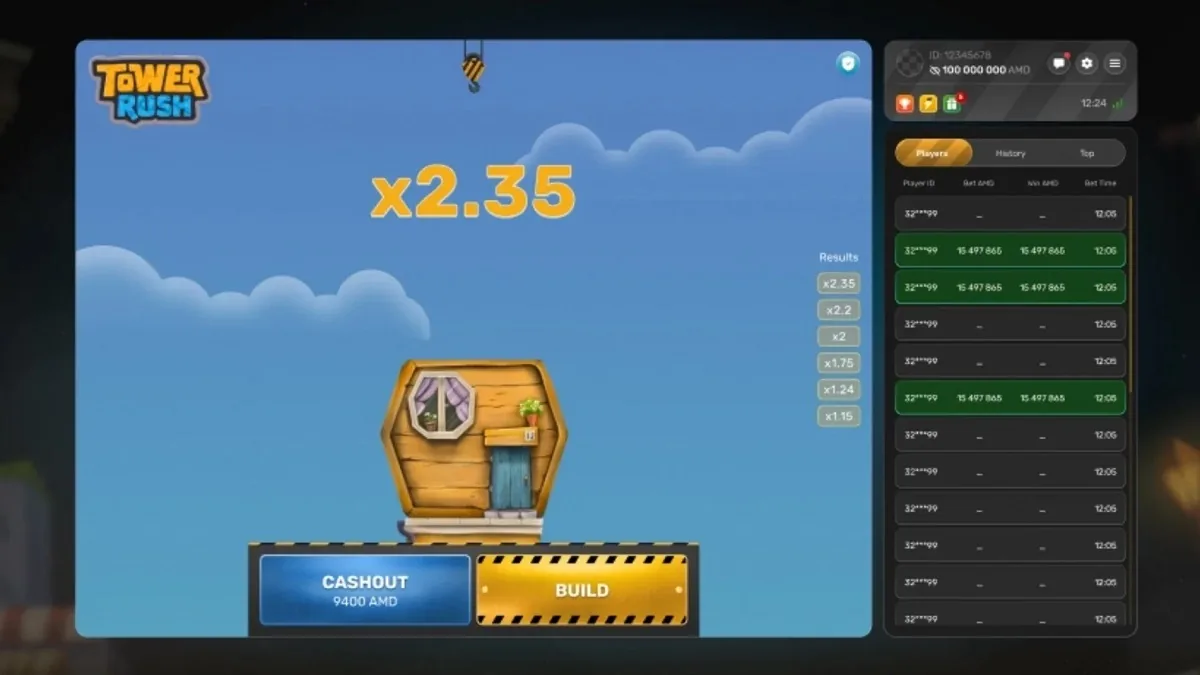
Most players cash out immediately after a freeze, which is exactly backwards. The freeze has already capped your downside for the rest of the round — continuing costs nothing beyond the stake you committed at the start. If you are ever going to push for a tall tower, the floor right after a freeze is the moment.
The one caveat is that "the frozen amount" is the total at the instant of the freeze, not the peak you reach afterwards. If you climb from a frozen ₹400 to ₹900 and then collapse, you receive ₹400, not ₹900. To bank the larger figure you still have to press Cash Out. The freeze protects a floor, not a ceiling.
Temple Floor opens a wheel with ten sectors. Six outcomes are possible, because four of the multipliers appear twice, and one sector is a free Frozen Floor.
The wheel multiplies your accumulated total, not your original stake — so the later a Temple Floor lands in a round, the more it is worth.
| Segment | Sectors | Chance | Effect on your accumulated total |
|---|---|---|---|
| x1.5 | 2 of 10 | 20% | Modest lift, most common outcome band |
| x2 | 2 of 10 | 20% | Doubles everything accumulated so far |
| x3 | 2 of 10 | 20% | Strong on a mid-height tower |
| x5 | 2 of 10 | 20% | Round-defining on a tall tower |
| x7 | 1 of 10 | 10% | The best multiplier outcome |
| Freeze | 1 of 10 | 10% | Locks the win instead of multiplying it |
The important detail is the base the multiplier applies to. Temple Floor multiplies your accumulated total, not your original stake. A x5 on a tower worth x2 gives you x10; the same x5 on a tower worth x8 gives you x40. That single fact is the strongest argument in the game against cashing out early on a round that is running well — and the reason a Temple Floor arriving at floor two feels like a much smaller gift than one arriving at floor nine.
Temple Floor can also trigger more than once in a round, unlike the freeze. Two Temple Floors on the same tower is uncommon but entirely possible, and compounding a x3 into a x5 is where most of the game's largest published wins come from.
Triple Build stacks three floors instantly, each carrying odds of x1 or better. It is the most frequent bonus in the game and the one players most often misread as unambiguously good.

Early in a round, when the tower is short and collapse odds are low, Triple Build is the fastest lift available: three compounding values in one click, with a guaranteed floor of x1 on each. That guarantee exists for a reason — ordinary floors can carry odds below x1, so Triple Build's minimum is a real improvement on the base game.
Late in a round the calculation inverts. Three floors means three chances to fail, taken simultaneously, on a tower that is already at its most fragile. A common approach among experienced players: treat a Triple Build above roughly x12 as a signal to cash out on the floor immediately after it lands, banking the lift rather than compounding the risk.
| Tower height when it triggers | Effect | Typical correct response |
|---|---|---|
| Floors 1–3 | Strong — low collapse odds | Keep building normally |
| Floors 4–7 | Good lift, moderate risk | Continue to your planned target |
| Floors 8–12 | Meaningful risk added | Consider taking the money soon after |
| Above x12 | Three collapse rolls at once | Cash out on the next floor |
Multiple Triple Builds in one round are possible, and compounding two of them is how a round jumps from interesting to memorable. It is also how a lot of tall towers end.
Bonus floors are triggered by the RNG, not by how you play. They redistribute variance inside a round — they do not change the long-run RTP.
Frequencies are approximate and observed rather than published — Galaxsys does not release trigger rates. What is documented is the structure: Triple Build is the most common, Temple Floor appears several times in a normal session and can repeat inside a round, and Frozen Floor is the rarest and is hard-limited to one occurrence per round.
None of this is predictable at the round level. Bonus floors are drawn from the same pre-generated sequence as everything else, which means a session with four Temple Floors and one with none are both entirely normal.
It depends entirely on when it arrives, which is why a flat ranking is misleading. Here is the version that actually helps.
| Situation | Best bonus to receive | Why |
|---|---|---|
| Round just started | Triple Build | Fastest compounding when collapse odds are lowest |
| Tower already tall | Temple Floor | Multiplies a large accumulated total |
| About to cash out | Frozen Floor | Removes the reason to stop; push instead |
| Playing a small balance | Frozen Floor | Protects the session more than it grows it |
| Chasing the win cap | Temple Floor | Only realistic route to the ceiling |
| Playing a bonus balance | Frozen Floor | Locked wins clear wagering more reliably |
Bonus floors are the most heavily marketed part of this game, so it is worth stating plainly what they are not.
What they genuinely do is redistribute variance inside a round: good rounds become better, bad rounds stay exactly as bad. That is a real design achievement and a real improvement to how the game feels to play. It is not an edge, and any source presenting it as one is not being straight with you.
Two different things share the word "bonus" here, and conflating them causes real problems at withdrawal time. The three floors above are game mechanics. Casino bonuses are promotional balances with terms attached.
| Bonus floors (in-game) | Casino bonus (promotional) | |
|---|---|---|
| Source | The game itself | The operator |
| Triggered by | RNG only | Deposit or promo code |
| Wagering requirement | None | Usually ×25 to ×40 |
| Expiry | None | Typically 7 – 30 days |
| Available in demo | Yes | No |
| Can be bought | No | Effectively, via deposit |
| Affects your withdrawal | No | Yes — terms apply |
Two clauses to check before accepting any casino bonus you intend to use here. First, game contribution: instant and crash games often count for less than slots towards wagering, and sometimes for nothing at all. Second, bonus activation: the bonus must be active before the round, and if the bonus balance sits below the minimum bet the game will refuse the wager. To bet cash instead, deactivate the bonus first.
Operator-by-operator terms: where to play Tower Rush.
Recurring themes from crash-game discussion threads, including the disagreements. Paraphrased in our own words, not direct quotes.
The freeze completely changes the round for me. Cautious before it lands, aggressive after — the downside is already capped, so stopping right after a freeze is throwing the protection away.
Triple Build at floor two is the best thing in the game. Triple Build at x14 has cost me more rounds than anything else. Same bonus, opposite meaning.
People underrate Temple Floor because they see it early and get a x1.5. Land one on a tall tower and it is a different game — it multiplies the total, not the stake.
Worth repeating every time it comes up: none of the three raise the RTP. They are already in the 96–97%. They change the shape of a round, not the maths behind it.
If you are clearing a bonus, check the contribution rate first. I assumed instant games counted the same as slots and lost most of a promo balance finding out otherwise.
There is no bonus buy, which I think is the honest choice. Nobody can pay their way to a Temple Floor, so everyone is on the same terms.
Demo mode runs on virtual credits with the same rules and bonus floors as real play. No registration, no deposit, no download — and no real-money winnings.
Every bonus floor appears in the demo at its normal frequency. The drill worth running: when a Frozen Floor lands, deliberately keep building until the tower collapses, and watch the frozen amount survive. Five repetitions of that costs nothing and permanently fixes the most valuable habit in the game. More demo practice notes.
It locks your current win. From that point a collapse cannot take the frozen amount, and only a larger win later in the round replaces it. Only one Frozen Floor can occur per round, and no further bonus floors appear after it.
Ten segments: two each of x1.5, x2, x3 and x5, one x7, and one Freeze. The multiplier applies to your accumulated total rather than to your original stake, so it is worth far more on a tall tower.
It instantly stacks three floors, each carrying odds of x1 or better. It is the most common of the three bonuses and can occur more than once in a round.
No. There is no bonus buy and no ante bet. All three floors are triggered by the RNG only, which is why nobody — including any site claiming otherwise — can sell you access to them.
No. Their value is already included in the published 96.12–97%. They redistribute variance within a round: they make good rounds better and leave bad rounds unchanged.
Triple Build is the most frequent, roughly every eight to twelve builds. Temple Floor turns up several times in a typical session and can repeat within a round. Frozen Floor is the rarest and is limited to one per round.
Usually not. The freeze has already capped your downside for the rest of the round, so continuing costs nothing beyond the stake already committed. Remember that the locked figure is the total at the moment of the freeze, not any higher amount you reach afterwards.
Yes for Temple Floor and Triple Build, which can both repeat. No for Frozen Floor — once it triggers, no further bonus floors appear at all.
Yes, all three, at the same frequency as real play. That makes the demo the cheapest place to learn how each one changes a round.